Ethical and Unethical issues related to marketing

Ethical Issues in Marketing
Ethical problems in marketing stem from conflicts and disagreements. Each party in a marketing transaction brings a set of expectations regarding how the business relationship will exist and how transactions should be conducted. Each facet of marketing has ethical danger points as discussed below.
Market Research
Some ethical problems in market research are the invasion of privacy and stereotyping. The latter occurs because any analysis of real populations needs to make approximations and place individuals into groups. However, if conducted irresponsibly, stereotyping can lead to a variety of ethically undesirable results.
Market Audience
Selective marketing is used to discourage demand from so-called undesirable market sectors or disenfranchise them altogether. Examples of unethical market exclusion are past industry attitudes to the gay, ethnic minority, and plus-size markets.
Another ethical issue relates to vulnerable audiences in emerging markets in developing countries, as the public there may not be sufficiently aware of skilled marketing ploys.
Delivery Channels
Direct marketing is the most controversial of advertising channels, particularly when approaches are unsolicited. TV commercials and direct mail are common examples. Electronic spam and telemarketing push the borders of ethics and legality more strongly.
Pricing Ethics
Bid rigging is a form of fraud in which a commercial contract is promised to one party, although for the sake of appearance several other parties also present a bid.
Predatory pricing is the practice of selling a product or service at a very low price, intending to drive competitors out of the market, or create barriers to entry for potential new competitors.

Pyramid Scheme: This business practice relies on getting the initial investor or “captain” to enroll others for a fee to them who in turn will also enroll others in order to get paid.
Key Points
- Each party in a marketing transaction brings expectations regarding how the business relationship will exist. For example, if a consumer wishes to make a purchase from a retailer, their expectations include wanting to be treated fairly by the salesperson and wanting to pay a reasonable price.
- Ethical marketing decisions and efforts should meet and suit the needs of customers, suppliers, and business partners. Unethical behavior such as price wars, selective advertising, and deceptive marketing can negatively impact a company’s relationships.
- Recent trends show that consumers prefer ethical companies. As a result ethics itself is a selling point or a component of a corporate image.
what is unethical issues of marketing:-
Using women as sex symbols for advertising
The rate at which even reputable brands are resorting to this unethical marketing practice is quite alarming. If you observe TV, billboard, and magazine adverts, there’s something common to most of them; a half-naked lady is used to attract attention to the product or service being advertised.
Using fear tactics
This is another common unethical marketing practice among snake oil salespersons. You will hear them saying something like: “This price is a limited-time offer. If you don’t buy now, you might have to pay much more to buy it later because the offer will end up in two days time, and the price will go up.” The only motive behind those statements is to prompt the potential buyer to make a decision on the spot. And that’s wrong.
Exploitation
This is charging for much more than the actual value of a product or service. For marketing efforts to remain with ethical limits; the prices of your offers must be equal to or less than the value they give the buyer. If the value is less than the cost, it’s unethical.
Spamming
Spamming is when you send unsolicited emails to potential customers, encouraging them to buy your products or services. This is the commonest unethical marketing practice done online. The number of time you send such emails doesn’t matter. Whether you send them once, or on occasions, or frequently, you remain a spammer.
Ethical and unethical issues related to HR(Human resource:-
Ethical issues in human resource:-
In short, an organization's culture can be at odds with what's the best thing to do for HR managers. As conflict arises, the HR manager must be adept at resolving conflicts between the demands of company culture and those of ethical behavior.
In short, an organization's culture can be at odds with what's the best thing to do for HR managers. As conflict arises, the HR manager must be adept at resolving conflicts between the demands of company culture and those of ethical behavior.
Major Issues in Ethical Management
Some of the major issues an organization deals with is handling ethical challenges in workforce diversity.
The following are some of the major ethical challenges an organization faces in ethical management −
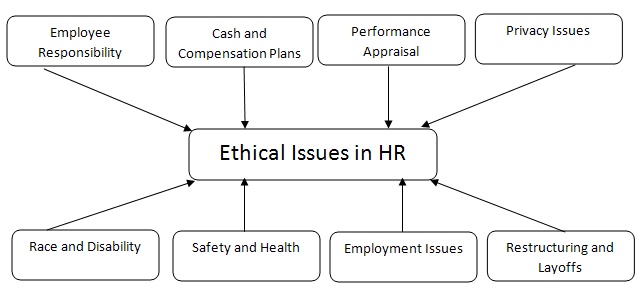
1. Race, gender and Disability
In many organisations till recently the employees were differentiated on the basis of their race, gender, origin and their disability. Not anymore ever since the evolution of laws and a regulatory framework that has standardised employee behaviour towards each other. In good organisations the only differentiating factor is performance! In addition the power of filing litigation has made put organisations on the back foot. Managers are trained for aligning behaviour and avoiding discriminatory practices.
2. Employment Issues
Human resource practitioners face bigger dilemmas in employee hiring. One dilemma stems from the pressure of hiring someone who has been recommended by a friend, someone from your family or a top executive.
Yet another dilemma arises when you have already hired someone and he/she is later found to have presented fake documents. Two cases may arise and both are critical. In the first case the person has been trained and the position is critical. In the second case the person has been highly appreciated for his work during his short stint or he/she has a unique blend of skills with the right kind of attitude. Both the situations are sufficiently dilemmatic to leave even a seasoned HR campaigner in a fix.
3. Privacy Issues
Any person working with any organisation is an individual and has a personal side to his existence which he demands should be respected and not intruded. The employee wants the organisation to protect his/her personal life. This personal life may encompass things like his religious, political and social beliefs etc. However certain situations may arise that mandate snooping behaviours on the part of the employer. For example, mail scanning is one of the activities used to track the activities of an employee who is believed to be engaged in activities that are not in the larger benefit of the organisation.
4. Cash and Compensation Plans
There are ethical issues pertaining to the salaries, executive perquisites and the annual incentive plans etc. The HR manager is often under pressure to raise the band of base salaries. There is increased pressure upon the HR function to pay out more incentives to the top management and the justification for the same is put as the need to retain the latter. Further ethical issues crop in HR when long term compensation and incentive plans are designed in consultation with the CEO or an external consultant. While deciding upon the payout there is pressure on favouring the interests of the top management in comparison to that of other employees and stakeholders.
5.Equal Opportunity
The HR managers must regularly monitor the company's hiring practices to make sure there is no discrimination in the hiring process based on ethnicity, sexual orientation, race, religion and disability. However, simply abiding with Equal Employment Opportunity Commission (EEOC) guidelines does not guarantee ethical behavior.
For example, if an HR manager recommends a candidate in order to fill a quota, that decision is unethical, because it will remove other applicants that may be more qualified.
6.Fair Working Conditions
Companies are basically expected to provide fair working conditions for their employees in the business environment, but being answerable for employee treatment typically means higher labor costs and resource utilization.
Fair pay and benefits for work are more obvious factors of a fair workplace. Another important factor is provision of a non-discriminatory work environment, which again may have costs engaged for diversity management and training.